Art Deco Furniture
Some links from this site lead to third parties who pay us a commission if you buy something. This allows us to keep providing the information on this site free of charge!
Discover the world of Art Deco furniture - the different styles, shapes and designs. . . . .
Are these bar stools below the style that first springs to your mind?
These are the later machine age inspired designs of the 1930s when new materials such as chrome and steel became all the rage.
But that's not how it all started.
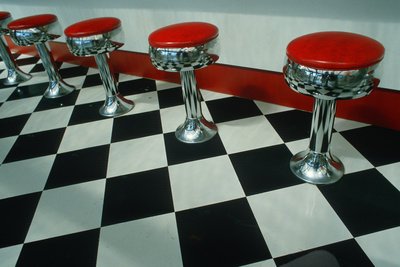 Red Chrome Stools
Find Out How It All Began. . .
It began in Paris in the 1920s.
Some of the most collected furniture today was made by the first Art Deco interior designers, who took their inspiration from the 18th and 19th century cabinet makers of Paris.
Their elegant pieces of fine craftsmanship were first seen at the 1925 Paris "Exposition Internationale des Arts Décoratifs et Industriels Modernes" from which Art Deco got its name.
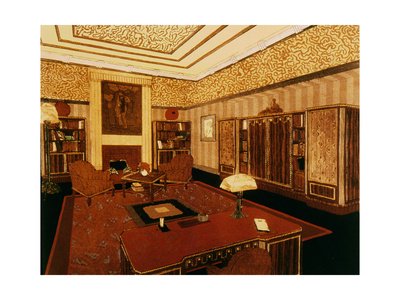 Office Furniture by Paul Follot
These makers included such desirable names as Jacques Emile Ruhlmann, Paul Follot and the Sue et Mare partnership.
Pieces by these designers are finding their way now into museums, and the collections of the international elite. The following print is of a gilt bronze and rosewood daybed by Ruhlmann.
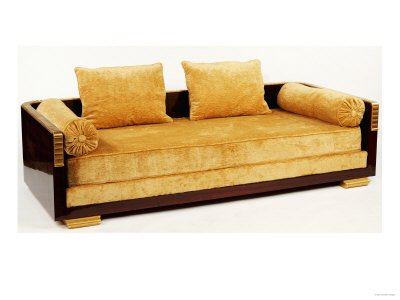 Print of Day Bed by Ruhlmann
Other collectable Paris designers in the “artiste decorateurs” tradition include:
Pierre Chareau – an architect and furniture designer with his own store – Maison de Verre
Pierre Legrain – made furniture with a strong African influence
Armand Albert Rateau – influenced by the Egyptian and the exotic and often used Bronze.
Jean Michel-Frank - loved pale woods, sharkskin, vellum and soft leather.
Eileen Gray - a reclusive Irish lady who established in Paris. Her lacquered wood furniture and tubular pieces were sold in her own Galerie Jean Desert from 1922 – 1930.
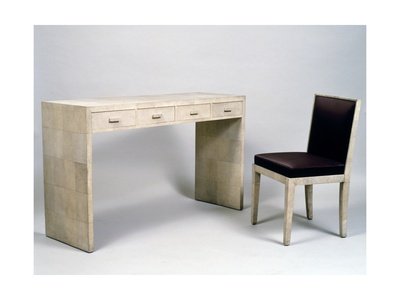 Desk and Chair by Jean-Michel Frank
In Britain the few designers who worked in the high end Art Deco style included:
Gordon Russell - his work blended the early Arts and Crafts movement with Art Deco influences from Paris.
Betty Joel
- her feminine Hollywood inspired pieces attracted elite clients from
the British Royal family and classy hotels such as the Savoy.
Art Deco Furniture - Materials
1920s French high end Art Deco furniture was made from the most fabulous woods such as ebony and burl walnut, maple or ash.
Towards the end of the 1920s ebony and other exotic woods were becoming scarce and exotic veneers from overseas such as Brazilian jacaranda, zebra wood, palmwood, and calamander. Other veneers such as sycamore, amboyna, mahogany and violet wood were also popular.
Inlays were of ivory, brass and mother of pearl. Pieces were finished with shagreen, (a type of sharkskin which was ideal for dressing table or desk tops) snakeskin, oriental silks, pony skins and other animal hides such as those used by Le Corbusier in the chaise pictured below.
Wrought iron and glass were just some of the other expensive materials used by such designers as Edgar Brandt and Charles Picquet for architectural elements and lighting.
Art Deco furniture was always polished to a very high sheen which gave it it's brilliance. Japanese lacquer was often used to achieve a very hard and shiny, tactile finish.
Eileen Gray, an Irish furniture maker who settled in Paris, went overseas especially to learn oriental lacquering and her furniture was highly sought after. But the lacquering process involved up to 22 layers of lacquer applied in a painstaking process, which made it too expensive for most. It was largely replaced by the 1930s by the advent of synthetic varnishes.
Art Deco furniture of this quality was not made a great deal outside Paris. Department stores such as Galeries Lafayette started to stock luxury furniture, so that it would be more widely available, but this highly opulent style didn't really take off outside France.
Exceptions to this were a few stores in Britain such as Heals of London and Gillows of Lancaster who stocked high quality imitations.
The First Interior Designers
Many of the Art Deco furniture makers were more than just cabinet makers. They designed entire interiors for their wealthy clients. Some were also architects, and built houses with the interiors already thought out and furnished.
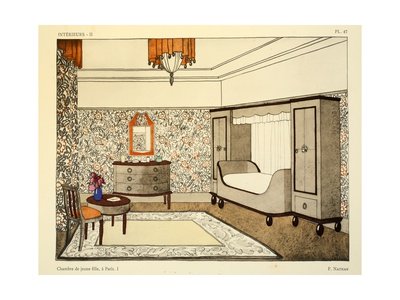 Young Girl's Bedroom by F. Nathan. View Full Size Print
A few British designers were influenced by high end Art Deco such as the Epstein Brothers and Ray Hille who used walnut and veneers, but it was only in the 1930s when mass production techniques and cheaper materials became available that Art Deco became a style for the middle classes instead of just the aristocracy and the fabulously wealthy.

Art Deco Furniture Reaches the USA
By 1930 Art Deco furniture had reached the USA, and stores were filling with a more modernist style of furniture with a streamlined look. Donald Deskey, who designed the interior of Radio City Hall, created hundreds of accessible furniture designs for department stores which made their way into the homes of ordinary people.
Paul Frankl was making an affordable range of skyscraper furniture in Manhattan inspired by the ever rising skyline of New York. He catered for the new high rise apartment dwelling trend setters, and his pieces were in black and red, steel and chrome, and essentially the forerunners of clever, space-saving modular furniture. His pieces are making a fortune these days!
Read more about Paul Frankl furniture in this excellent book by Christopher Long:
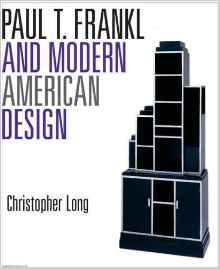
Bauhaus and Modernist Architects
In the 1930s, especially in the USA, modernism from the Bauhaus school and architects such as Le Corbusier and Mies van der Rohe took over.

There was also a strong influence from the architect Frank Lloyd Wright
whose furniture as early as 1908 was highly prescient of what was to
come. Lloyd Wright's barrel chair of 1908 looks like pure Deco! See what it looks like here.
Other 1930s furniture makers in the USA included Warren McArthur and Norman Bel Geddes.
A
few other countries had their Art Deco furniture designers which are
now highly collectable. Many Scandinavian designers used pale curved
plywood, which was a new technique for the 1930s, and was the beginning
of a uniquely Scandinavian furniture style. In Finland, the husband and
wife team Alvar Aalto and Aino Marsio are collected today for their
curved and streamlined, or geometric laminated Birch furniture.
There has been a resurgence in the popularity of 1930s Art Deco furniture recently in Europe, the USA and Australia. Design classics such as the Le Corbusier chaise and the Mies van de Rohe Barcelona chair are still being reproduced and even sold in miniature versions as ornaments! I saw the Le Corbusier chaise in miniature being sold for 300 British pounds on a home décor show the other day!
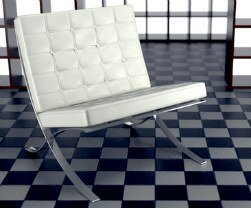 Barcelona Chair by Mies van der Rohe
New
Art Deco style furniture is being built now by some high quality
craftsmen, with streamlined looks, dark woods and pale upholstery. It
has a feel of Hollywood glamour with shiny polished woods and curved
form.
Another trend I've noticed recently, which owes it's
inspiration to Art Deco is mirrored furniture with chrome accessories.
Some of it is really so over the top it's a must have item for a high
bling factor!
Don't be afraid of
looking further afield than your local area. Sometimes delivery is not as expensive as you
might imagine.
To find out more, why not read up on How to Buy
Art Deco Furniture.
There's lots more information on Art Deco furniture in the following pages:
Etsy has a surprisingly good range of Art Deco furniture, interior decor, art and prints, 1920s and 1930s fashion, accessories, jewellery and Bakelite. Click the banner to explore.
Join our Facebook Page so you never miss a thing!
Like this Page
- Decolish Home
- Furniture
Recent Articles


-
Edward Mcknight Kauffer - Painter, Poster Artist, Rug Designer
 The Story of E. Mcknight Kauffer, a lesser known, but hugely important Art Deco poster artist. See his works and learn more. . .
 -
Art Deco Engagement Rings - We Help you Choose the Best
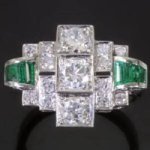 Find exquisite Art Deco Engagement rings to buy for all budgets....beautiful and a great investment too.
 -
Art Deco - Antiques of the Future
 Why Art Deco Will Become Antiques Very Soon - What to Look for and How to Buy them.
Etsy has a huge range of Art Deco as well as 1920s and 1930s Fashion. Check them out!
Copyright Lesley Postle 2009-2024 Decolish.com
Privacy Policy | Affiliate Disclaimer | POWered by Solo Build It
